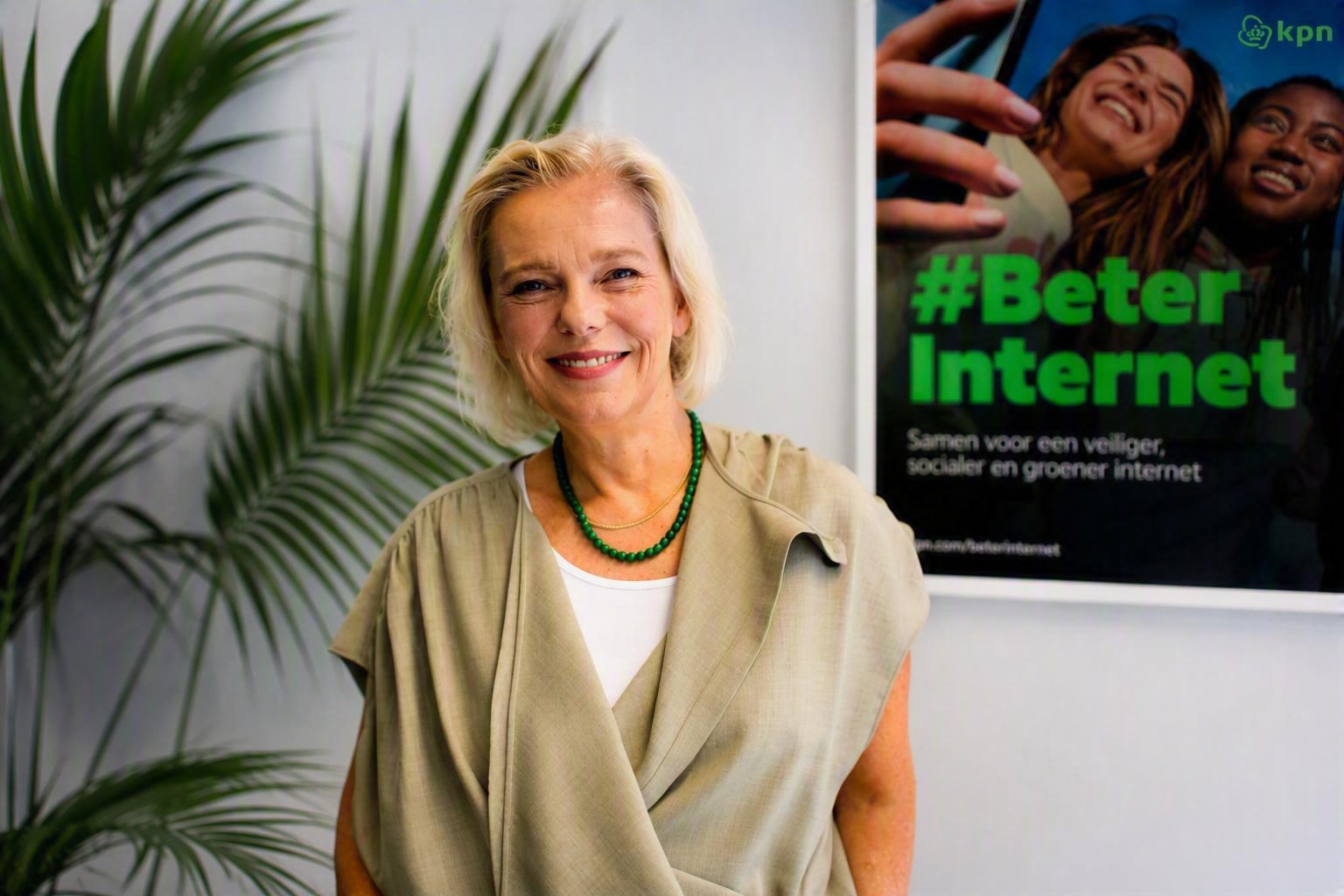
The digital backbone of the Netherlands
Telecom companies are the silent infrastructure beneath our digital society. For KPN, that role goes beyond technology: it is about security, reliability, inclusivity and sustainability. Executive Marieke Snoep sees artificial intelligence (AI) as a catalyst that touches all of these themes. Not only in operations, but above all in the boardroom, where choices are made while the outcome is still uncertain.
AI as a societal engine
Snoep calls herself a technology optimist. For her, AI is not a hype but a means of solving real societal problems. She points to applications in healthcare, the financial sector and debt counselling, where AI reduces stress, improves accessibility and helps people make better decisions. She sees the same potential for telecom: from energy reduction to security and inclusivity.
What if KPN stopped using AI tomorrow?
A provocative question from the conversation: what would happen if KPN switched off all its AI systems?
According to Snoep, the impact would be felt immediately:
- Lower quality and speed of service. Proactive outage notifications, personalised wifi optimisation and fast problem diagnosis would disappear.
- Less sustainable operations. AI helps KPN lower energy consumption while data usage grows exponentially.
- Less security and resilience. AI detects anomalies, prevents incidents and supports customers in staying safe online.
In short: AI is already deeply woven into the service, often without customers realising it.
AI in an executive's daily work
Snoep uses AI intensively herself, not as a toy but as structural support:
- Research agents for company visits
- Quick analyses of customer data and business results
- Automatic summaries of conversations
- Creative support for speeches and communications
- Optimisation of social media posts
AI speeds up her work, but it also calls for new routines. Cognitive load rises, which makes rest and recovery more important than ever.
The human side of digital transformation
One of the most urgent themes for Snoep is employee wellbeing. AI changes work rhythms, increases intensity and shortens natural breaks. She names three big questions:
- Will my job still exist? Call centre work is changing fast because of voice agents.
- How will my job change? Preparation and follow-up work disappears, while more complex tasks remain.
- Can I handle this technology? Not everyone adopts AI equally easily.
KPN is therefore investing in adoption teams, awareness and guidance. Snoep argues for a working week with recovery moments built in, not only at weekends or on holiday.
AI requires a different organisation
According to Snoep, the biggest bottleneck in AI implementation is not technology but the organisation. AI forces companies to break down silos and work across disciplines: legal, UX, architecture, customer channels and the business have to move together.
An example: during the development of voice agents, the architecture turned out not to scale because of latency problems. Employees had to have the courage to say: this doesn't work. And the organisation had to have the courage to go back to the drawing board, adjust its ambitions and shift resources.
"Employees had to have the courage to say: this doesn't work."
No separate AI strategy, but an integrated approach
KPN deliberately chooses an integrated strategy. AI is not a standalone programme but a means woven into the business:
- Optimisation of network rollout
- Commercial opportunities
- Sustainable architecture
- Governance and ethical AI
- Continuous adaptation to regulation
A separate AI strategy would be too static in a world that changes this fast.
Intelligent service becomes the differentiator
Snoep is clear: tomorrow's telco winner will no longer stand out on connectivity, but on intelligent service. That means:
- Faster-than-real-time problem solving
- Hyper-personalisation based on context
- Security and digital resilience
- Services that understand and are trusted by customers
AI makes telecom not only smarter but more human, provided it is applied well.
The biggest challenge for the coming year
For Snoep, the biggest challenge lies in the boardroom: radically adapting the way of working. AI calls for different roles, different mandates, different collaboration and different rhythms. It is a transformation that is not only technological, but above all human.